The following guides introduce the fundamental concepts of LoopBack 4 required to build scalable, maintainable, and consistent APIs. If you want to try it out locally follow the instructions in Installation.
To complete the steps in this tutorial, you need to install Node.js and the LoopBack 4 command line interface (CLI). 1. Install Node.js version 14 or higherSee the Node documentationfor installation instructions. 2. Install LoopBack 4 CLIThe LoopBack 4 CL
Overview This tutorial demonstrates how to create a basic API for a todo list using LoopBack 4. You will experience how you can create REST APIs with just 5 steps.
LoopBack 4 comes with the following tutorials: todo: Tutorial on building a simple application with LoopBack 4 key concepts using bottom-up approach. soap-calculator: Tutorial on integrating SOAP web services. log-extension: Tutorial on building a log ext
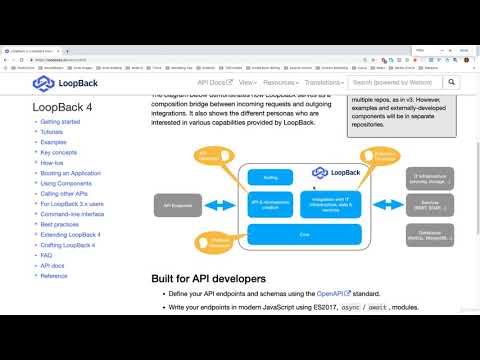
The diagram below demonstrates how LoopBack serves as a composition bridge between incoming requests and outgoing integrations. It also shows the different personas who are interested in various capabilities provided by LoopBack.
But, there is a powerful contender gaining steam: LoopBack, an open source API framework built by StrongLoop, the creators of Express. Let’s take a closer look at LoopBack and it’s capabilities by turning everything into practice and building